Warning: Your browser doesn't support all of the features in this Web site. Please view our accessibility page for more details.
|
Symbolic computing packages, such as Maple, are wonderful tools for exploration and experiment, but are typically too slow for large-scale applications. Numerical computing tools, such as Matlab, can be highly efficient (if used properly) but lack the facility for symbolic manipulation. However, a new Matlab-based system called Chebfun is trying to change that. A student who undertakes this project would investigate the mathematics that underpins the system, while developing new programmes and examples to solve problems with chebfuns. A particularly interesting example might be the (numerical) solution of certain PDEs. You should consider this project if you like numerical analysis and programming. |
|
|
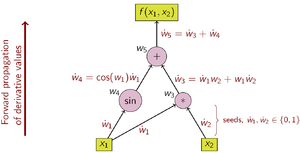
Given a function, it is not hard to construct a numerical scheme to estimate its derivatives at certain points. However, it is easy to show that such schemes are highly susceptible to numerical error. Automatic differentiation is an approach based on repeated use of the chain rule and which can be applied to arbitrary functions and should be accurate to machine precision. It can be particularly useful in problems where one needs to find derivatives of vector-valued functions (Jacobians...). This project will begin with reading a recent article: Introduction to Automatic Differentiation and MATLAB Object-Oriented Programming, Richard D. Neidinger. SIAM Rev. 52, pp. 545-563. The ideas and tools will be developed and applied to (I hope!) some interesting but non-trivial problems. |
|
| Why not come up with your own idea? A good place to start would be the Education articles in SIAM Review. Or read some mathematical blogs. The most famous is Terry' Tao's. David Gleich's blog features some neat ideas and demos. Or you could go to the library and have a look at such titles as
|